
Know what your suppliers can actually prove.
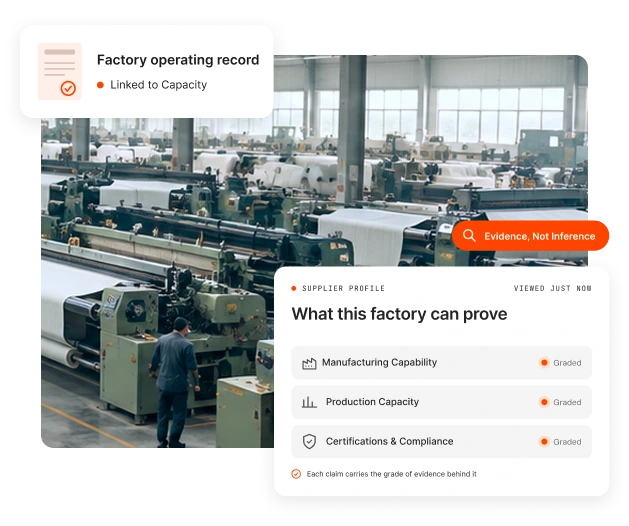
Most supplier intelligence is inference: built from shipping records and questionnaires, describing factories nobody has entered. Provena Source is built the other way around. Claims come from the factory's own operating record, each one carrying the grade of evidence behind it.
Capability, capacity and certifications, shown with what stands behind them, at the moment you look.

 Building to

Three sources, one defect.
The question is always the same one. How do you know?
A brand choosing suppliers works from an agent's recommendation, an audit report commissioned and paid for by the factory being audited, and whatever the factory puts in its own profile. All three share the same flaw: the information originates with the party it judges.
Platforms built on trade data solve a different problem. They tell you what moved and between whom. They cannot tell you what is true inside a building they have never entered, and when a regulator or a customer asks for proof, what moved is not the question.
- 01Self-declaredThe factory stated it
- 02Document-backedAttached and dated
- 03Cross-checkedTwo independent parties agree
- 04Independently auditedA named auditor, on a stated date
Four things, concrete.
Discovery that is actually searchable
Find factories by product, place and certification. Every fact names its source and the date it was last checked.
Every claim carries its grade
You see the difference between a factory that says it holds a certification and one whose certificate has been checked. The grade travels with the claim, wherever it goes next.
Passport data into the systems you run
We publish in standard formats, built to the UN Transparency Protocol and the CEN specifications for digital product passports. If you already run a traceability platform, our data arrives inside it. We are not asking you to switch.
Your entry and your evidence, together
What a shipment declares at the border and what the factory record says about the goods inside it, in one place, so a forced-labor inquiry or a classification question does not start with a week of reconciliation.
Deep in one corridor, rather than shallow everywhere.
Our density is in Bangladesh and South Asia apparel, where our platform runs inside the factories themselves. If that is where you source, nobody can show you more about your suppliers than we can, because the record starts on their floor rather than at a port.
If your exposure is somewhere else, say so in the first conversation and we will tell you plainly whether we can help. A platform that claims the whole world is claiming something no buyer should accept without checking.
“What about the suppliers I already have?”
You nominate them. We onboard them under your name, and you get a consolidated view across the set: the same graded claims, from the same operating records, for the factories you already buy from.
For the factory it is not a cold sale from a vendor they have never heard of. It is their customer asking, which is the only thing that has ever reliably moved this industry. They enter their data once and satisfy several buyers with it, so participation gets cheaper the longer they stay.
Nominate your suppliers- 1 of 4You nominateYour supplier list
- 2 of 4We onboardUnder your name
- 3 of 4They enter onceSatisfies several buyers
- 4 of 4You see the setGraded, consolidated
In the rooms where the rules are written.
Supplier evidence is only worth what your systems and your regulators will accept. We work inside the bodies defining those rules, so what reaches you is built to what the market will actually take rather than to a format we invented.
IDSA
Member of the International Data Spaces Association, which defines how sovereign data exchange works between organizations that do not fully trust each other. That is the architecture underneath any credible cross-border traceability claim.
Catena-X
Member of the Catena-X network, the furthest-developed industrial dataspace in Europe, and the template much of textile traceability is following.
UNTP
Building to the UN Transparency Protocol, the emerging global grammar for product passports and supply-chain credentials outside the EU regime.
Evidence that arrives in a form your platforms already read, and that holds its meaning when it is passed to a customs broker, an auditor or a regulator who has never heard of us.
The paperwork is becoming the product.
Claims need documents
Zero-tariff treatment for apparel made with US-origin cotton and fiber requires documenting input origin at product level. The benefit is capped and conditional, and a factory that cannot evidence where its fiber came from cannot access it, which makes it your problem as much as theirs.
The burden is yours
Rebutting a detention sits with the importer, in the form of a documented chain back through fabric, spinning and cotton origin. That chain either exists before the shipment is stopped or it does not exist at all.
2028, and buyers already asking
The EU textile regime takes effect from 2028 and the technical standards were cited in the Official Journal in July 2026. Brands are asking for composition, origin and chain of custody now, because collecting upstream data takes a year.
If it needs to work differently for you.
Most buyers use Provena Source as it comes. Some need it bent to fit systems they already run, or have a related problem the same engineering solves. Our team builds both.
- Integration
Into the stack you already have
Passport and supplier data mapped to your schema and delivered into your traceability platform, PLM or ERP, with a conformance suite and a connector maintained against standard revisions. You do not switch systems to get the evidence.
- Your own record
When the evidence lives in six places
Entity resolution across your systems, a claim model with evidence grades, and lineage that survives a migration: the canonical supplier record underneath whatever you build next. Most often the thing that was skipped before an earlier program stalled.
- Adjacent
AI your own reviewers will sign
Grounded retrieval over your contracts, specifications and supplier correspondence, with span-level citation, abstention when the record is silent, and a signed answer carrying the model version. The same discipline you see in the grades here, applied inside your four walls.
- Where to start
A two-week look first
A fixed-fee diagnostic on your own documents: duty overpaid or unclaimed, and how well your origin record would hold up if somebody asked. A deliverable either way, and nothing larger quoted until we have looked.
Your supplier sent you a record.
What happens next.
This is how most buyers meet us: not through a search or a sales call, but because a factory they already buy from sent them a product record. Nothing is required to read it. Signing in is what turns one record into a view of the supplier behind it.
- Step 1The link arrivesBy email, by WhatsApp, or as a QR on the carton. It resolves here regardless of which platform the factory used to issue it.
- Step 2No accountYou read the recordClaims with the grade of evidence behind each one, the signature check, who issued it and when. Open to anyone holding the link.
- Step 3You ask the obvious questionWhere did this come from, and can I get it from my other suppliers? A band beneath the record answers the first and offers the second.
- Step 4Signed inThe supplier opens upThe record becomes a supplier. Their full profile, their other passports, chain depth, and your own list.
| What you see | Before signing in | Once signed in |
|---|---|---|
| The record itself | Full claims and grades, signature check, issue date | Same, plus the evidence documents behind each claim where the factory shares them |
| The factory | Name, country, categories | Full graded profile: capability, capacity, certification positions, grade distribution |
| Chain depth | Not shown | Tier by tier for this style, with gaps shown as gaps |
| Their other records | Not shown | Every passport this factory has issued that it shares with you |
| Your own suppliers | Not shown | Nominate the rest of your base and see the same for all of them |
| Requests | Not available | Ask this factory for what is missing, and for a US shipment, for a pre-filing attestation |
A passport a factory sent to its customer must open for that customer, every time, with no account and no barrier. Gating it would break the thing the factory is using it for, and the factory, not us, decides who receives which view.
Who signs in, and how they arrive.
One account covers Provena Source and Provena Trust. A company chooses what it is at registration, and a company can be more than one thing, which is common for a trading house that both buys and makes.
Brands and importers
Register, name your company, and start with your own supplier list. Discovery and the public directory are open before you sign in; the workspace, requests and attestations need an account.
Factories and exporters
The partners you need to reach are global, so you connect from here too. If you already work in Provena Trust you arrive already signed in: same session, same account.
Customs brokers
A broker is invited by the importer, for a shipment. The invitation opens the record it covers; from there the broker has a standing account for every importer that names them.
Auditors and certification bodies
Granted access by the company being assessed, scoped to what that company shares. Conformity results they issue become credentials attached to the claim they support.
Regulators and customs
Receive the regulator view of a passport. They send nothing and configure nothing.
An invitation link
If a trading partner invited you, the link shows who invited you, what will be exchanged and which view you receive, before you accept. Sign in or register from that page.
Each broker serves many importers. A broker invited once for a single shipment becomes a route to every importer on their book, which is why the invitation flow is built properly rather than treated as an afterthought.
The workspace, by who you are.
The left rail changes with the company type and the person's role. Every screen carries a sandbox or production switch at the top, colored differently, so nobody mistakes a test for a live exchange.
/connectIdentity card summary, partners by status, and a needs-attention list: failed checks, pending approvals, expiring keys.
- Harbour MillsSandbox exchange failed its schema checkfailed · schema mismatch
- ApprovalsTwo go-live sign-offs waiting for an approverInvited
- Signing keyProduction key expires in 12 daysnot run · rotation not started
- Identities exchanged passed · both keys valid
- Sandbox exchange failed · schema mismatch
- Approver sign-off not run · waiting on exchange
Illustrative: names and numbers are examples.
Start with your own supplier list.
Send us the factories you buy from and we will show you what is already known about them, and what is not. No obligation, and no platform to adopt to find out.